Watch the Episode
This episode is presented as a vertical short with ad-free Vimeo playback.
The page below explains the logic mistake in the story and connects it to broader principles in philosophy and Islamic law.
This short Doctor G Science episode tells a true story from adolescence: how a seemingly airtight chain of reasoning turned vinegar into a problem, ketchup into a theological hazard, and potato chips into collateral damage. The lesson is bigger than food. It is about overgeneralization, false premises, essentialist thinking, and how Islamic legal reasoning guards against unnecessary restriction.
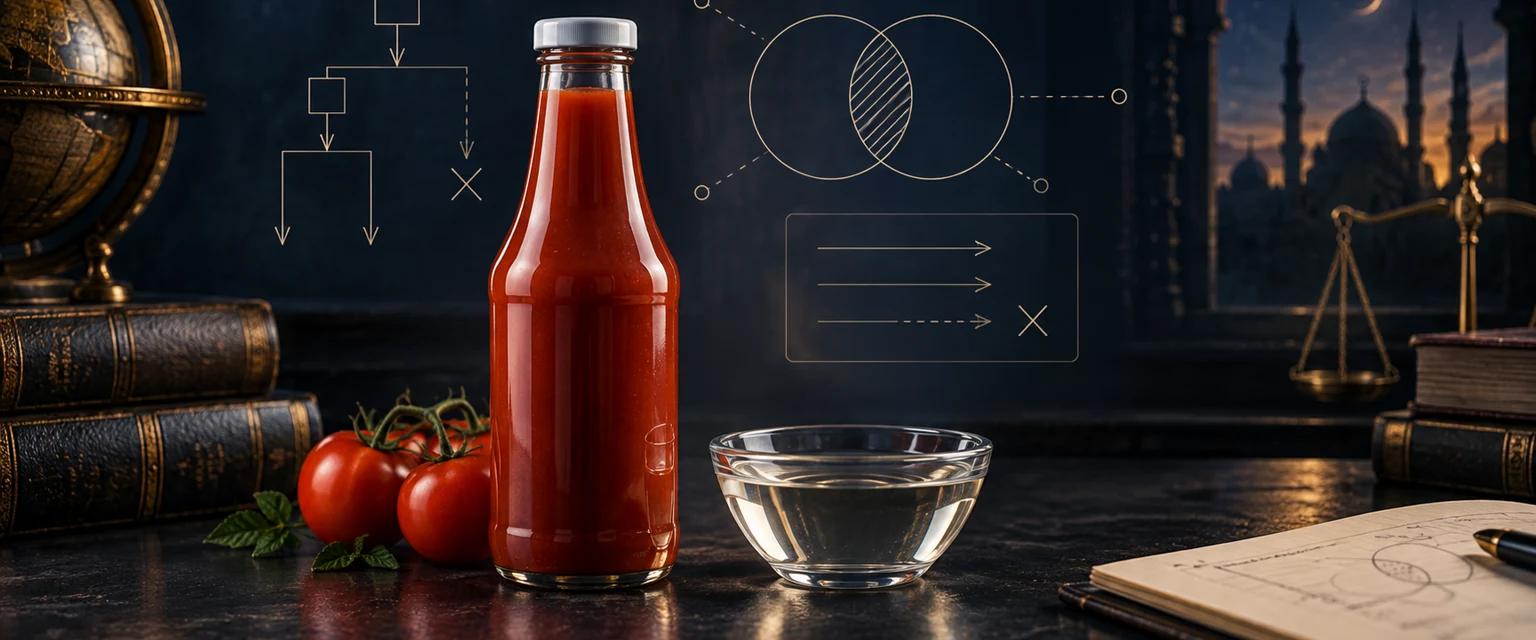
This episode is presented as a vertical short with ad-free Vimeo playback.
The page below explains the logic mistake in the story and connects it to broader principles in philosophy and Islamic law.
The story begins with a hadith: “Whatever intoxicates in large amounts is forbidden in small amounts.” Then came a fact that seemed relevant: vinegar may contain trace alcohol during or around fermentation. From there, a teenage mind built a neat chain: alcohol is forbidden, vinegar has alcohol, ketchup contains vinegar, therefore ketchup must also be forbidden.
The chain felt logical, but it quietly slipped outside the intended scope of the hadith. The rule addresses intoxicants. Vinegar is not an intoxicant. That single mistaken assumption infected every later step.
A central theme of the episode is the philosophical distinction between a valid argument and a sound one.
In the ketchup story, the structure of the argument was valid. If the premises had been true, the conclusion would have followed. But the argument was not sound because the key premise was false: vinegar was wrongly treated as if it were an intoxicant.
Vinegar is not simply alcohol hiding in another form. It is produced when alcohol is chemically converted into acetic acid by bacteria during fermentation. The intoxicating substance is transformed. That matters.
The issue is not merely that vinegar contains tiny traces of something once related to alcohol. The issue is that the substance in question is no longer functioning as an intoxicant. So the hadith about intoxicants does not automatically carry over to vinegar, let alone to every product that contains it.
The video identifies two reasoning errors.
That is how the logic spiraled from alcohol to vinegar, from vinegar to ketchup, and from ketchup to chips. Each step looked orderly, but the chain drifted further from the original principle.
Islamic scholarship contains an important corrective to this kind of reasoning: the default state of things is permissibility.
That means foods and ordinary matters are considered halal unless there is clear evidence showing otherwise. This principle prevents people from creating unnecessary prohibitions by chasing remote causal chains or trace associations.
Without that safeguard, daily life would become unworkable. Almost anything could be linked, indirectly and absurdly, to something problematic.
When I was a teenager, I read a statement of the Prophet Muhammad, peace be upon him, that said: “Whatever intoxicates in large amounts is forbidden in small amounts.”
Then one day, I read in an encyclopedia that vinegar contains about 0.25% alcohol. And I thought: wait a minute. Alcohol is forbidden. Small amounts are forbidden. Vinegar contains alcohol. So vinegar must be haram.
I declared to my family that we could not buy or use vinegar. Problem solved. Except that was just the beginning. I was reading the ingredients on the back of a ketchup bottle and learned it contained vinegar. If vinegar is haram, then ketchup must be haram. No more ketchup in our house.
Later, someone offered me ketchup-flavored potato chips. Unacceptable. And if ketchup is haram, then potato chips with ketchup seasoning... For about a year, I was warning people about these dangerous, ketchup-based theological risks.
Until one day, I discovered something slightly embarrassing. The Prophet Muhammad, peace be upon him, himself said: “What an excellent condiment vinegar is.” So clearly, vinegar is not haram. Which meant my entire logical chain had collapsed.
What went wrong? At first glance, the reasoning looked perfectly logical. But it contained a hidden mistake called overgeneralization. The hadith applies to substances that intoxicate. Wine intoxicates. Vinegar does not.
In fact, vinegar is made when alcohol is chemically converted into acetic acid by bacteria during fermentation. The intoxicating substance is gone. So vinegar is not wine anymore.
In other words, my logic was valid, but it was not sound. In philosophy, an argument is valid if the conclusion follows the steps. My steps were perfect. But an argument is only sound if the facts you start with are actually true. My premise that vinegar is an intoxicant was dead wrong.
Additionally, my teenage brain had committed a classic reasoning error: essentialist thinking. I assumed that if something once contained alcohol, or even traces of it, then the prohibition must follow it forever. That led to a cascading chain of conclusions: alcohol to vinegar to ketchup to chips.
Each step looked logical, but the chain had drifted far away from the original rule. I was worrying about degrees of freedom I could not control. It is like tipping a waiter and then staying awake at night wondering if they will use that dollar to buy something immoral. Logic becomes absurd when you try to own the entire chain of causality.
If you follow the trace-amounts logic to the end, you eventually cannot eat anything, because every molecule on Earth has likely been part of something else at some point.
Islamic scholarship actually guards against this kind of mistake. There is a famous legal principle: “The default state of things is permissibility.” In other words, things are halal unless clear evidence proves otherwise. Not the other way around. Alhamdulillah.