Watch the Episode
Tip: If the video will not play here, click Watch on Vimeo.
Note: this episode is presented in horizontal orientation.
At-Tariq—the Night-Visitor—is explored through pulsars, black holes, supernovae, life from gushing water, and the possibility that rare cosmic “knocks” helped shape DNA.
Tip: If the video will not play here, click Watch on Vimeo.
Note: this episode is presented in horizontal orientation.
The opening verses of Surah At-Tariq begin with an oath:
“By the sky and At-Tariq. And what will make you realize what At-Tariq is? The Piercing Star.”
The episode emphasizes the Quranic phrase wa mā adrāka mā-t-tāriq—“what will make you realize what At-Tariq is?”— as a signal that the object is not immediately obvious from ordinary perception. The surah then answers: an-najm ath-thāqib, the Piercing Star.
Later, the surah shifts from the cosmic sign to the human being: there is a recorder over every soul, and humanity is asked to consider what it was created from—gushing water emerging from between sulb and tarā’ib.
Pulsars are collapsed stars that spin rapidly and emit rhythmic radio pulses. When converted into audio, their pulses can sound like knocks or beats. This makes them a popular candidate in discussions of At-Tariq.
The episode’s concern is that pulsars fit the “knocking” quality well, but may not fully satisfy the stronger idea of a piercing star that physically transforms life on Earth.
A black hole is the ultimate hidden visitor: beyond the event horizon, even light cannot escape. The episode also notes that black holes can show rhythmic X-ray flickers, called quasi-periodic oscillations.
Black holes also connect conceptually to information conservation—the idea that information is not truly destroyed. This resonates with the verse that every soul has a recorder over it. But the episode argues that black-hole emissions are still not the strongest fit for “piercing.”
A supernova is a star that can remain unnoticed or ordinary until it explodes, striking the surrounding universe with high-energy radiation. X-rays and gamma rays from such events can be meaningfully described as piercing.
In this framing, the supernova becomes the strongest candidate for a rare, transformative cosmic strike: a hidden star that announces itself by a momentous event and leaves consequences in planetary atmospheres, geology, and biology.
The episode does not reject the common interpretation that these verses remind human beings of their humble origin in reproductive fluid. Instead, it explores an additional allegorical layer.
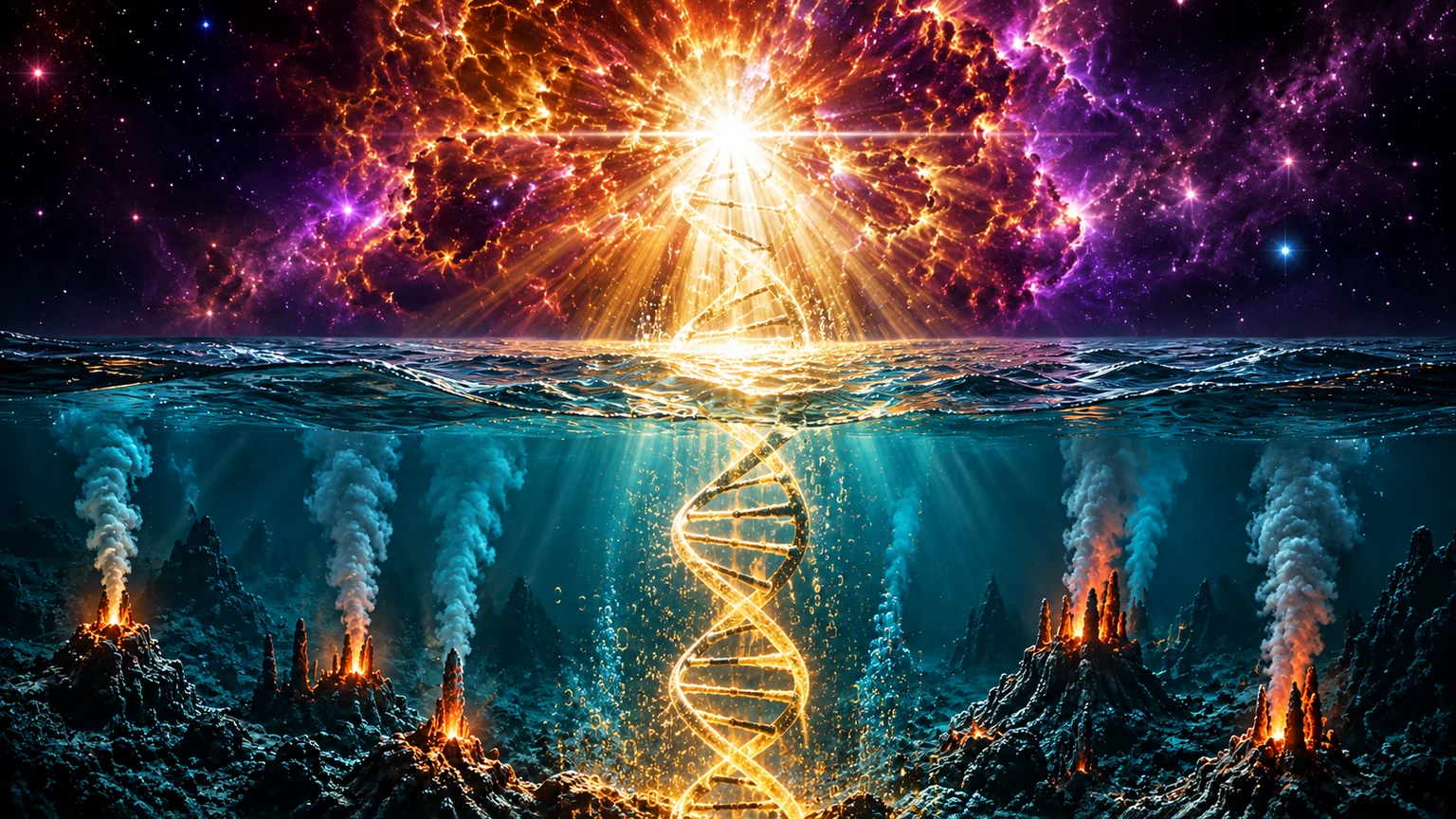
On this reading, the language evokes life emerging from dynamic water between structured layers: a striking parallel to hydrothermal vent environments, which many origin-of-life models consider important for early biochemical chemistry.
The episode contrasts different kinds of cosmic “knocking”:
The script estimates that within about 100 light-years of Earth, one supernova occurs roughly every 3 million years. Across the history of life, this yields roughly 1,300 rare cosmic “knocks” that may have helped drive mutation, stress, selection, and evolutionary change.
One especially intriguing example is the detection of radioactive iron-60 associated with a nearby supernova event around 2.6 million years ago, during a period of environmental change and important developments in the human lineage.
In ancient Arabic, Tariq was a "Night-Visitor." A traveler you could NOT see in the dark, who announced their presence to your camp by striking their staff against the ground: taraqa.
So, it is interesting that in the Quran’s chapter 86, God swears an oath by the sky and by at-Tariq, the Night-Visitor who knocks, but then the Quran asks, "And what will make you realize what At-Tariq is?"
“Wa-samā’i wa-t-tāriq”
“Wa mā adrāka mā-t-tāriq?”
This rhetorical question is a pattern in the Quran. It’s also used for Laylat al-Qadr, Al-Qaari’ah, and Yawm ad-Deen, and a few other terms. The pattern of when the question “ma adraka” is used is clear: the object refers to realities beyond our immediate perception—things we know by name, but not in essence.
Linguistically, the “Al” in Al-Tariq is an encompassing article. We aren’t just talking about one visitor; we’re talking about an archetype, a class of things hidden from our sight that reveal themselves through "strikes."
The Quran immediately answers the rhetorical question.
“An-najm uth-thāqib”
"The Piercing Star." Today, we’re peeling back the layers of astrophysics to find the real "Striker" behind the verse.
If you look up "scientific miracles" related to At-Tariq, you’ll find the Pulsar. These collapsed stars spin rapidly, emitting rhythmic radio pulses that sound like a knocking door when converted to audio.
It’s a compelling fit, but as a researcher, I ran into a problem. Pulsars are stars and are "audible" via radio telescopes, but are they "piercing"? Do they physically interact with our world in a way that justifies the term An-Najm ath-Thaqib? Generally, no. They are beautiful cosmic clocks, but they lack the transformative power described later in the Surah.
So, let's look deeper—to the Black Hole, such as Sagittarius A* at the center of our galaxy. It is 26,000 light-years away and 4 million times more massive than our Sun. This is the ultimate "Invisible Guest." Within its event horizon, even light cannot escape. It satisfies the Ma adraaka mystery, why God had to tell us about it, because it is literally unseeable.
Black holes also "knock." They exhibit Quasi-Periodic Oscillations (QPOs)—rhythmic flickers in X-ray emissions that encode information about the black hole itself.
And the next verse also made black holes a good fit for at-Tariq. The verse goes:
“In kullu nafsin lammā ‘alayhā hāfidh”
"There is no soul but has over it a recorder."
This perfectly mirrors the Law of Information Conservation from physics: the idea that data is never lost to the universe. Think of space as tiny volumes containing "bits"—like a computer. Information can be scrambled by entropy, but it cannot be destroyed. When the Quran says every soul has a recorder, it implies that your "data"—who you are—is never lost. Not a single bit.
But there is a problem. While black holes store information, are hidden, and knock, X-ray emissions from them are also not strong enough to be considered piercing.
So, let’s consider one more candidate for the "Striker": the Supernova. A supernova is a star that was once hidden or unremarkable until it suddenly explodes, striking the universe with a wall of ionizing radiation. This radiation—X-rays and Gamma rays—truly "pierces" through atmospheres and DNA.
Before we continue with supernovae, consider the next three verses:
“Fal-yandhuril-insānu mimmā khuliq. Khuliqa mim-mā’in dāfiq. Yakhruju mim-baynis-sulbi wat-tarā’ib.”
"Let people consider what they were created from! Created from gushing water, emerging from between the sulbi and tara’ib."
Literally, the sulb refers to the backbone, and the tara’ib to the rib cage or upper chest. The most common interpretation is that mankind is being reminded of their humble origin in seminal fluid. Other interpretations see the sulb as representing the male and the tara’ib the female, pointing to the interaction that leads to human creation. Some modern researchers even note that early reproductive structures develop near the spine before migrating.
Without contradicting these explanations, we can step back and examine the underlying language, perhaps gaining an additional allegorical meaning. In Arabic, the root of the word sulb conveys hardness, rigidity, and structural strength. The root of tara’ib is associated with dust, earth, and fine particles.
In geology, we see a similar contrast between the Earth's rigid interior layers and its more granular outer layers. And deep in the ocean, between such layers, hydrothermal vents release superheated, mineral-rich water—gushing fluid—environments that many scientists believe played a critical role in the early chemistry of life.
This offers an intriguing parallel: life emerging from dynamic processes deep within structured layers. “Let man consider what they were created from, created from gushing water emerging from between the sulbi and taraib.”
This is where the Supernova comes in. Life may have begun in these vents, but it needed a 'spark' to evolve. Supernovae provide the mutagenic ‘knocks’—bursts of high-energy, ‘piercing’ radiation.
To understand the scale, consider the frequency. A person knocks on a door once a second. A Pulsar is like a high-frequency hum, knocking up to 700 times a second. A Black Hole like Sgr A* is a rhythmic flicker, knocking perhaps once every 20 minutes.
But the Supernova is a rare and momentous strike. Statistically, within 100 light-years of Earth, one occurs every 3 million years. So, there were the roughly 1,300 'Mutagenic Knocks' that have signaled 'software updates' to the history of DNA since life first emerged on our planet.
One of these strikes—about 2.6 million years ago—dusted the Earth with radioactive Iron-60. This cosmic 'knock' coincided with a period of rapid environmental change and the accelerated brain development that defines our own human genus.
If the first verses of surah at-Tariq focus on man’s origins on Earth and the preservation of his information, the chapter's powerful second half focuses on man’s last days and return to God. Those themes are explored in Part 2 of this series.