Deep time. Bigger questions.
Dinosaurs ruled Earth for millions of years.Does the Quran mention them?
Ancient giants. A world-changing extinction. Descendants that still fly above us. Explore five possible connections between their story and the Quran.
Watch at your own pace
One question. Five possible connections.
Doctor G Science · 29 min 37 sec
The live page will show the ad-free player. Chapter controls are ready to use there.
Jump to a chapter 10 chapters
- Dinosaurs and the Quran
- Scientific milestones
- Why no direct mention?
- Historical and symbolic reasons
- Mighty generations: a metaphor?
- Evolution and how animals move
- Vertebrates and the rise of mammals
- The asteroid and mass extinction
- Earlier extinctions and surviving birds
- A world made tame: the closing reflection
Times follow the original YouTube version’s automatically generated chapters. Titles are shortened for this page.
The idea in 30 seconds
Three things to know about dinosaurs in the Quran:
They are not named directly.
Could descriptions of once mighty populations of the past, their destruction, and their traces on the earth carry a deeper connection to them?
Five connections to consider.
The episode proposes indirect and metaphorical readings. Explore each alongside the verse’s immediate context.
Their story is still alive.
Birds belong to the dinosaur family tree. The next bird you see is a living link to that ancient world.
First, a little science
An ancient world. A living legacy.
A simplified timeline · not to scale
- ~230 millionyears ago · Triassic
Early dinosaurs appear
Small early dinosaurs begin a long, branching evolutionary story.
- ~150 millionyears ago · Jurassic
Giants & early birds
Huge sauropods live in a world that also includes early birds such as Archaeopteryx.
- 66 millionyears ago · end-Cretaceous
A world-changing impact
An asteroid helps trigger a mass extinction. All non-bird dinosaurs disappear.
- TodayThe story continues
Look outside your window
Surviving bird lineages give rise to the birds around us, from sparrows to ostriches.
Explore the evidence: dinosaur history, the extinction, and the link to birds — Natural History Museum.
A small surprise: is a sparrow really a dinosaur?
Yes. In the scientific family tree, birds are part of the theropod dinosaurs. They did not appear only after the asteroid struck: birds already lived alongside other dinosaurs. Some bird lineages survived the extinction, and their descendants are still with us.
Read. Reflect. Explore.
Where might the connections be?
The Quran does not name dinosaurs explicitly. The episode proposes that their story may be present through indirect references and metaphor. Open any question to explore the reading and the passage it draws on.
01Could “mighty generations” evoke dinosaurs?Power, disappearance, and the traces left behind · 50:36
Dinosaurs can make us think about the limits of power. Even enormous, successful animals were vulnerable when their world changed.
The episode explores a possible metaphor in verses about powerful populations that vanished but left traces behind. In that reading, fossils invite us to reflect on a world that once seemed unshakable.
وَكَمْ أَهْلَكْنَا قَبْلَهُم مِّن قَرْنٍ هُمْ أَشَدُّ مِنْهُم بَطْشًا فَنَقَّبُوا فِي الْبِلَادِ هَلْ مِن مَّحِيصٍ
The verse in context: This passage speaks about earlier peoples and their destruction. Connecting that imagery to dinosaurs is an additional metaphorical reading. It does not mean that animals carry human moral responsibility.
▶︎ Watch this discussion · 05:2302Why mention two legs before four?Water and the different ways animals move · 24:45
Quran 24:45 describes creatures made from water and different ways of moving: on the belly, on two legs, and on four.
Could that order echo the dinosaur story? Early dinosaurs walked on two legs, while some later branches included huge four-legged animals. The episode connects the opening reference to water with life’s much earlier aquatic history.
وَاللَّهُ خَلَقَ كُلَّ دَابَّةٍ مِّن مَّاءٍ فَمِنْهُم مَّن يَمْشِي عَلَىٰ بَطْنِهِ وَمِنْهُم مَّن يَمْشِي عَلَىٰ رِجْلَيْنِ وَمِنْهُم مَّن يَمْشِي عَلَىٰ أَرْبَعٍ يَخْلُقُ اللَّهُ مَا يَشَاءُ إِنَّ اللَّهَ عَلَىٰ كُلِّ شَيْءٍ قَدِيرٌ
The distinction: The verse lists ways creatures move; it does not explicitly give an evolutionary timeline. Evolution also branches: four-legged animals existed before dinosaurs, and many dinosaurs remained two-legged.
▶︎ Watch this discussion · 09:0403Could stages of creation tell a larger story?From early life to a world of mammals · 23:12–14
The episode reads the stages in Quran 23:12–14 on a broader scale: from life’s beginnings to animals with skeletons, and eventually to the rise of mammals.
In this interpretation, the transition to a new creation can evoke the great change after the dinosaur extinction. Mammals already existed alongside dinosaurs; surviving mammals later diversified into many new forms.
The verse in context: These verses describe human creation and development. Applying their stages to the history of life is the episode’s broader interpretation, rather than an explicit reference to dinosaurs in the text.
▶︎ Watch this discussion · 12:5504Could a devastating blast recall an asteroid?A protective sky and a sudden catastrophe · 41:9–13
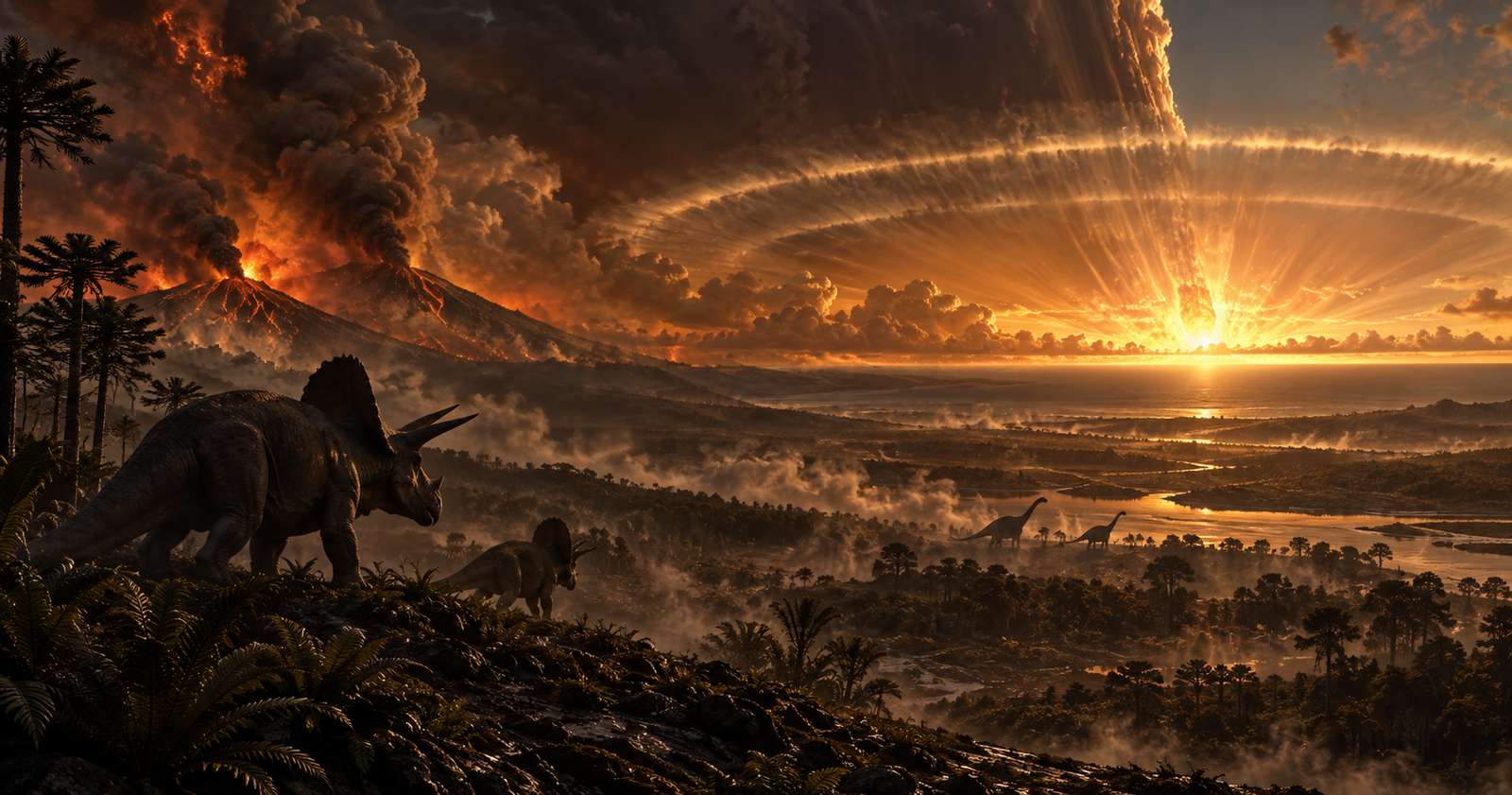
About 66 million years ago, an asteroid struck what is now Mexico. Its effects disrupted the climate and food webs, contributing to the extinction that ended the age of non-bird dinosaurs.
The episode connects a sky described as guarded with the warning of a destructive blast in Quran 41:13. It proposes that the imagery can also be read as a metaphor for the asteroid catastrophe.
The verse in context: The warning names ’Ad and Thamud. The asteroid connection is a proposed parallel; the verse itself does not name an asteroid, dinosaurs, or the end-Cretaceous event.
▶︎ Watch this discussion · 15:2805Are the birds above us part of the answer?A living link to the dinosaur world · 67:14–19
The episode’s final connection is the closest to everyday life. Quran 67:19 draws attention to birds spreading and folding their wings. Science places those birds within the dinosaur family tree.
The episode reads this passage, together with the preceding verses about Earth and destruction, as a reflection on survival and mercy. The creatures above us carry a legacy that stretches back into the age of dinosaurs.
The distinction: Birds are explicitly mentioned; their dinosaur ancestry is established through scientific evidence. Seeing that ancestry as a further layer of meaning is the episode’s interpretive connection.
▶︎ Watch the background · 19:09For the curious reader
A little further, if you like.
Read a short episode summary
The episode begins with a question: if dinosaurs were such a major part of Earth’s history, might the Quran refer to them? It proposes that a reference could be indirect or metaphorical and considers why early readers might not have understood an explicit description.
The episode then explores five possible connections: mighty populations that vanished; the ways animals move; stages of creation; a destructive blast; and the birds that survive today. Its central proposal is that familiar passages can invite reflection on the rise, extinction, and living legacy of dinosaurs.
This is an edited summary, not a word-for-word transcript. Use the chapter links above to explore the complete episode.
Sources, verse context & image credits
- The episode: Five Dinosaur References in the Quran, Doctor G Science, August 31, 2025. The reflections above summarize the episode’s argument. Chapter times follow YouTube’s automatic markers; the 27:28 bird-verse link follows the transcript.
- Natural history: Natural History Museum — When did dinosaurs live?, What killed the dinosaurs?, and How dinosaurs evolved into birds. The Australian Museum: What is a dinosaur?
- Read the passages: 50:36, 24:45, 23:12–14, 41:9–13, and 67:14–19. Quran.com provides Arabic text, translations, and tafsir. English descriptions on this page are summaries, not direct translations.
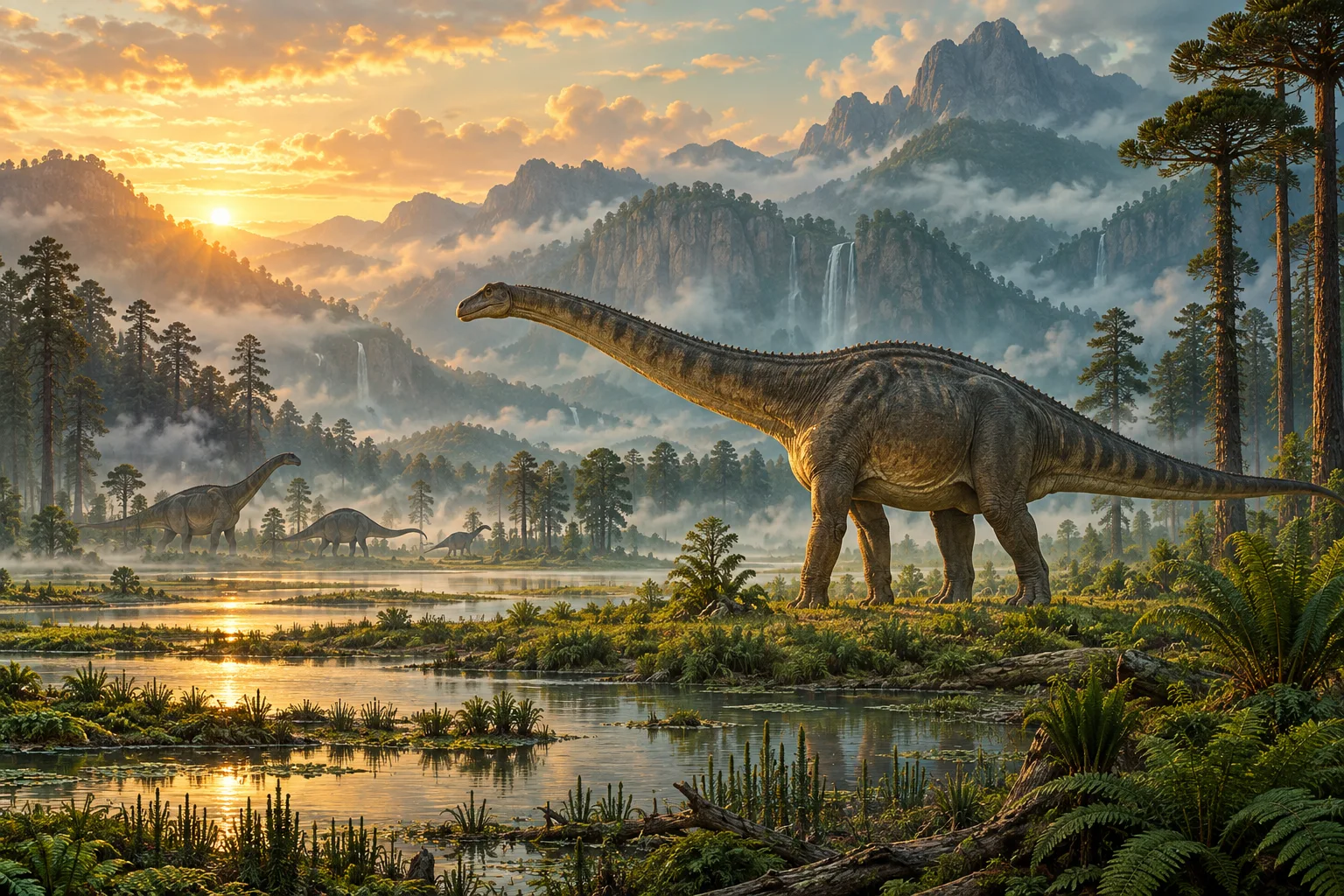
- Hero illustration: AI-generated conceptual paleoart created for Doctor G Science. The scene illustrates an imagined Jurassic environment; it is not a fossil photograph or a reconstruction of a particular fossil site. Related-video artwork comes from the site’s existing episode images.
Follow the story