A world changed. A question to explore.
Lut and the Triassic mass extinction.
About 201 million years ago, a mass extinction reshaped life on Earth. Watch the episode, then explore the science behind this turning point.
Watch at your own pace
Lut and Triassic Mass Extinction
The video plays on an approved Vimeo domain.
Jump to a chapter 10 chapters
- The question: a world about to change
- Pangaea and the volcanic crisis
- Warnings and the first blow
- Darkness and volcanic winter
- A land overturned
- Rescue, refuge, and survival
- From cooling to lasting warming
- An enduring catastrophe
- The parallel and its meaning
- The choice facing us today
Chapter starts follow the supplied timed transcript; titles are shortened for this page.
The Quranic story
Lut, his people, and a morning of destruction.
Lut—known in English as Lot—is presented in the Quran as a messenger to his people. His story brings together warning, defiance, rescue, and catastrophe.
Who was Lut, and what did he warn against?
In 26:162, Lut identifies himself as a trustworthy messenger. In 29:28–30, he rebukes his people for sexual wrongdoing involving men, mistreating travellers, and misconduct in their gatherings. They respond by challenging him to bring the punishment he warns about.
What happened when the messengers arrived?
Surah Hud 11:77–81 describes Lut’s distress when visitors arrive and his people rush toward his house. He appeals to them not to disgrace him through their treatment of his guests. The visitors reveal that they are messengers from his Lord and reassure him that his people cannot reach him.
Who escaped?
The messengers tell Lut to leave with his family during the night. His wife is excepted from the rescue and will share the fate of the others. The appointed time of destruction is the morning. Read 11:81.
How is the destruction described?
11:82–83 describes the settlement being overturned and stones of hardened clay raining down upon it. The passage’s imagery combines upheaval from below with destruction from above.
These descriptions provide the Quranic background to the episode’s subject. Watch the episode’s discussion ↑
Summaries of the linked passages, rather than direct translations.
The episode’s central connection
An initial shock. A lasting catastrophe.
The episode compares the sequence in Lut’s story with the End-Triassic crisis: warnings, sudden darkness, upheaval, refuge, and enduring destruction. These are parallels between a human story and an event in deep time.
01What happens when warnings go unheeded?Quran 54:33, 36
Surah Al-Qamar describes Lut’s people rejecting repeated warnings. The episode sets that refusal beside ecosystems fitted to conditions that were about to change.
The comparison asks what happens when a familiar way of life meets a crisis it cannot withstand. Lut’s people could choose a different course; species could only respond through the traits and circumstances available to them.
▶ Watch this connection · 1:5702Why does the episode begin with a loss of light?Quran 54:37
When the mob seeks to violate Lut’s guests, 54:37 describes their eyes being effaced. The episode reads this sudden blindness as a first blow before the final catastrophe.
Its geological parallel is an initial volcanic winter: sulphur emissions form aerosols that reflect sunlight, producing rapid cooling. A 2024 study of CAMP eruptions proposes that these concentrated cold shocks played a major role in the extinction.
The connection centers on the sequence: an abrupt loss of light, followed by a much longer crisis.
▶ Watch this connection · 2:1003A land overturned—and destruction from above?Quran 11:82
The document highlights the description in 11:82: the settlement is overturned and stones of hardened clay rain down.
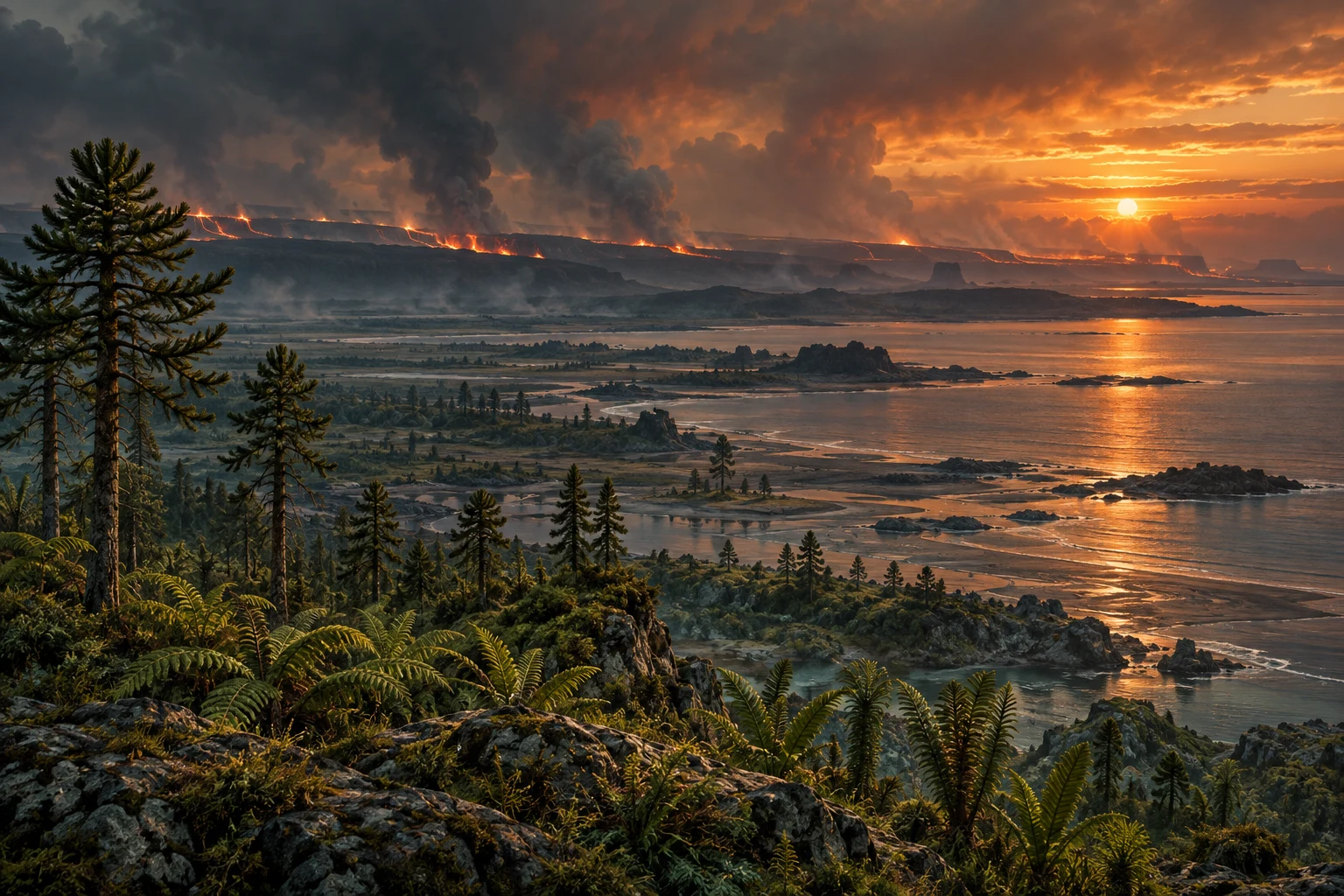
The episode places this imagery beside Pangaea’s fracturing crust, flood-basalt lava spreading across the land, and volcanic plumes filling the atmosphere. The proposed parallel joins upheaval below with destruction arriving from above.
The volcanic system was the Central Atlantic Magmatic Province, or CAMP. The video follows its geological traces from Nova Scotia and the Palisades to Morocco and Brazil.
▶ Watch this connection · 3:0204Why does rescue before dawn matter?Quran 54:34–35
54:34–35 describes Lut’s family being saved before dawn, as a blessing. The episode focuses on their separation from danger before the decisive catastrophe.
It compares this with organisms that already possessed useful traits or occupied sheltered environments when the extinction struck. Those existing advantages could improve survival; species could not choose new adaptations as the crisis began.
The episode points to early dinosaurs and traits such as insulation as possible advantages during the volcanic cold. Survivors went on to shape the Jurassic world.
▶ Watch this connection · 4:0205What makes the catastrophe enduring?Quran 54:38–39
In 54:38–39, the punishment arriving in the morning is described as enduring. The episode highlights ‘adhābun mustaqirr as a catastrophe that persists.
It connects that language with repeated volcanic pulses and lasting environmental stress. Sulfate aerosols clear relatively quickly, while accumulated carbon dioxide can drive longer-term warming. The video follows this into ocean acidification, oxygen loss, and disrupted ecosystems.
The parallel is a crisis that compounds: the first shock passes, but its consequences continue.
▶ Watch this connection · 5:27What does the episode ask of us today?
The closing reflection brings the two narratives into the present. It asks us to recognize environmental warning signs and act before damage compounds.
As the episode puts it, extinction carries no morality: species do not sin or choose their genomes. Humans, however, can recognize consequences and change course. That capacity for choice is the heart of its closing appeal.
▶ Watch the closing reflection · 6:48Connections summarized from the supplied script, with verse references from the Word document and video links from the timed transcript.
The science in 30 seconds
Three things to know about the end-Triassic extinction:
A turning point in deep time.
About 201 million years ago, losses on land and in the oceans marked the end of the Triassic Period.
Volcanism changed the environment.
Enormous volcanic activity released gases that disrupted the climate and ocean conditions.
Dinosaurs survived.
As many other groups declined, surviving dinosaurs went on to diversify during the Jurassic.
Before. Crisis. After.
The threshold of the Jurassic.
- Late TriassicBefore the crisis
A varied living world
Dinosaurs share the land with other reptiles. Marine life fills the seas.
- ~201 millionYears ago
A major extinction
Large-scale volcanism and environmental disruption accompany widespread losses.
- JurassicAfter the crisis
Survivors diversify
The surviving lineages shape a new chapter in the history of life.
Simplified timeline, not to scale. Explore the periods with the Natural History Museum.
Follow your curiosity
What happened to life?
01How could eruptions affect a whole planet?From volcanic gases to changing habitats
The eruptions associated with this interval were immense. Gases released during volcanic activity affected the atmosphere and the oceans, placing ecosystems under pressure.
Carbon dioxide and sulphur dioxide played roles in environmental change. The important picture is a chain of effects reaching far beyond the lava itself.
02What changed in the oceans?Marine animals and disrupted food supplies
Changing temperatures and ocean chemistry made survival harder for marine life. Giant ichthyosaurs disappeared around this transition, while smaller relatives survived.
Losses among smaller animals also affected the creatures that fed on them.
03Why did this matter for dinosaurs?A different extinction from the one that ended their reign
Dinosaurs survived the end-Triassic crisis. With many other large land animals gone, they diversified and became increasingly prominent during the Jurassic.
The extinction that eliminated non-bird dinosaurs came much later, about 66 million years ago, at the end of the Cretaceous.
Science sources
The background above draws on the Natural History Museum’s accounts of dinosaur history, ichthyosaurs, and giant marine reptiles at the Triassic–Jurassic boundary. The timeline is a simplified guide.
Follow the story