Watch the Episode
Tip: If the video will not play here, click Watch on Vimeo.
Note: this episode is presented in horizontal orientation.
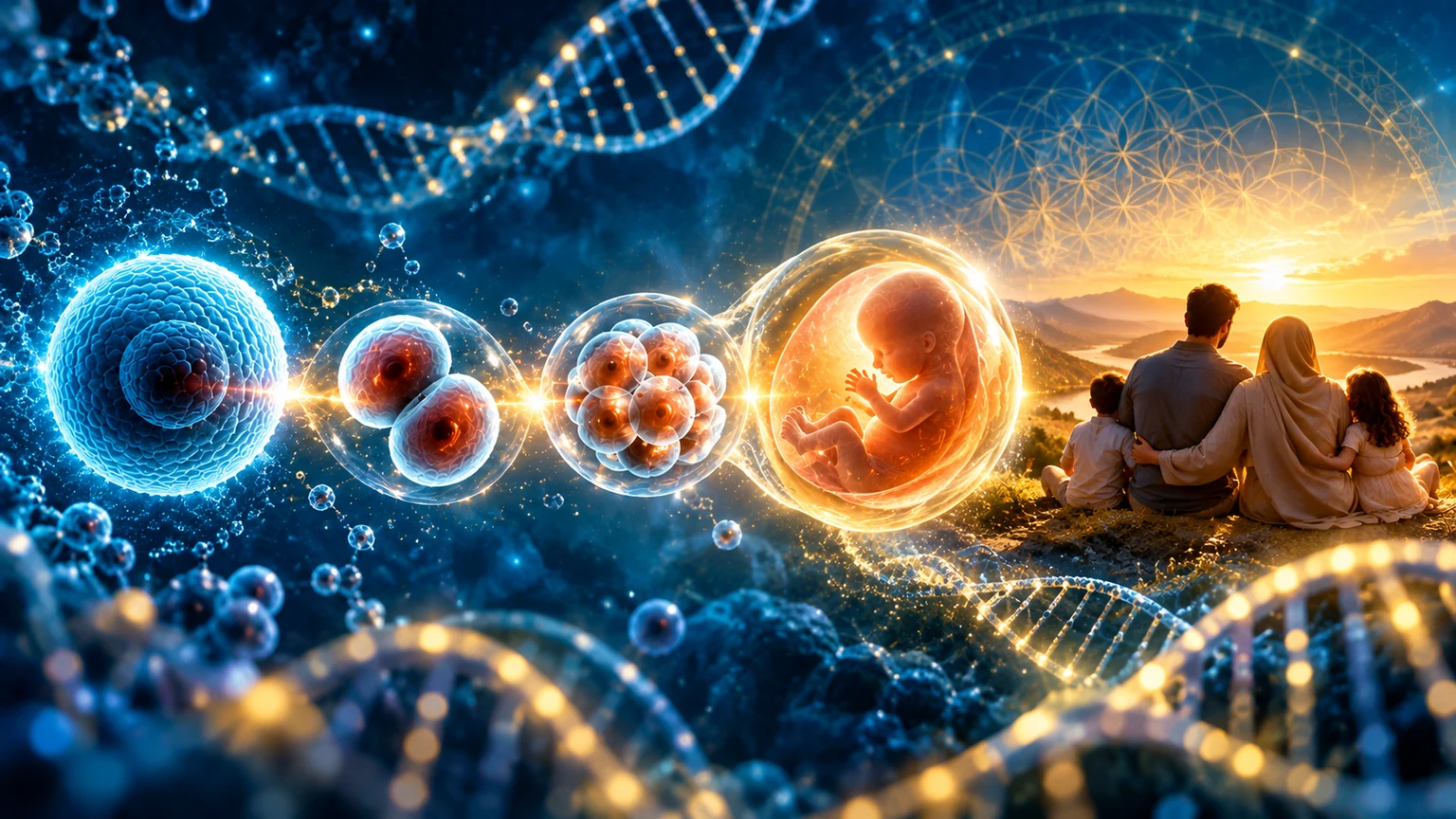
Quranic ideas of nafs, zawj, and sukoon meet the biological history of reproduction—from genetic diversity to parental investment, family life, and prayer.
Tip: If the video will not play here, click Watch on Vimeo.
Note: this episode is presented in horizontal orientation.
Asexual reproduction is efficient because one organism can reproduce alone, but it produces offspring that are nearly identical to the parent. That creates vulnerability: if a disease or environmental pressure affects one, it may affect the whole population.
Sexual reproduction changed that equation by combining genetic material from two complementary cells or organisms. The result is genetic diversity, which improves adaptability and provides a biological form of security across generations.
As life evolved, reproductive strategies also changed: many organisms produced large numbers of offspring with little care, while others developed nests, protection, pregnancy, nursing, teaching, and extended family support. Human beings represent an especially heavy form of parental investment because children require years of care, education, protection, and moral formation.
يَـٰٓأَيُّهَا ٱلنَّاسُ ٱتَّقُوا۟ رَبَّكُمُ ٱلَّذِى خَلَقَكُم مِّن نَّفْسٍۢ وَٰحِدَةٍۢ وَخَلَقَ مِنْهَا زَوْجَهَا
O humanity! Be mindful of your Lord Who created you from a single soul, and from it He created its mate…
(Quran 4:1, excerpt)
He is the One who created you from a single soul and created from it its mate.
(Quran 7:189, excerpt)
Glory be to Him who created all pairs from what the earth grows, from themselves, and from things they do not know.
(Quran 36:36)
God has made for you from yourselves mates and has made for you from your mates children and grandchildren.
(Quran 16:72, excerpt)
Sexual Reproduction, Human Evolution, and a New Reading of Quran 7:189
Sexual reproduction may be one of the most important innovations in the history of life.
For billions of years, life reproduced asexually. A cell would simply divide into two identical copies. While this method is efficient, it has a weakness: offspring are nearly identical to their parents. When environments change or diseases emerge, an entire population can become vulnerable.
At some point, roughly 1.2 to 2 billion years ago, early eukaryotic cells developed a new strategy. Initially, these single cells reproduced strictly through mitosis—cloning themselves. But over time, a single cell evolved the ability to divide into specialized, complementary mating types; from that single living entity, its biological counterpart was formed, requiring them to unite to pass on life. Instead of reproducing alone, genetic material from two cells could combine before offspring are produced. This new process created genetic diversity, allowing populations to adapt more effectively to changing environments.
The result was one of the greatest evolutionary breakthroughs in Earth's history. Sexual reproduction eventually gave rise to the incredible diversity of plants, marine life, terrestrial animals, and ultimately human beings.
Interestingly, the Quran repeatedly speaks about life being created in pairs.
In the Chapter of Women, Surah An-Nisa, God says:
يَـٰٓأَيُّهَا ٱلنَّاسُ ٱتَّقُوا۟ رَبَّكُمُ ٱلَّذِى خَلَقَكُم مِّن نَّفْسٍۢ وَٰحِدَةٍۢ وَخَلَقَ مِنْهَا زَوْجَهَا
"O humanity! Be mindful of your Lord Who created you from a single soul, and from it He created its mate,” (4:1)
A similar statement appears in the Chapter of the Heights, Surah Al-A'raf:
"He is the One who created you from a single soul and created from it its mate." (7:189)
Most classical scholars understood these verses as referring to Adam and Eve, and that remains the traditional interpretation. However, the Quran does not begin those verses by saying that a male was created and then a female from him. Instead, it begins with a single nafs—a living self or source—from which a complementary mate emerges. Importantly, nafs is grammatically feminine in Arabic, but grammatical gender is not the same as biological sex. The emphasis is therefore on a common origin before the resulting paired mates.
The Quran also uses the word zawj (pair or mate) broadly, applying it not only to humans, but also to animals and plants. God says:
"Glory be to Him who created all PAIRS from what the earth grows, from themselves, and from things they do not know." (36:36)
In other words, the concept of pairing extends to plants, animals, and humans. Pairing appears to be presented as a universal principle woven into creation itself.
But the Quran gives a deeper reason for pairing than reproduction alone.
In both Surah Al-A'raf and Surah Ar-Rum, the chapter of the romans, we are told that mates were created so that we may find sukoon with them.
The Arabic expression litaskuna ilayha is often translated as "that you may find tranquility in her."
The root sakana carries meanings of dwelling, stability, peace, safety, and security.
At the human level, this refers to emotional companionship, affection, mercy, and family life.
But from a biological perspective, sexual reproduction also provides another form of security. By continually mixing genes, populations become more resilient to disease, environmental change, and extinction. Genetic diversity becomes a form of biological protection.
As life evolved, reproduction became increasingly complex.
In biology, early reproduction was a light burden; asexual cell division or spawning thousands of eggs into the water required zero parental investment. As life evolved, a middle stage emerged with reptiles and birds, where parents began investing in nests and defending their eggs—a noticeable shift, yet still limited. But as mammals and ultimately humans evolved, pregnancy, childbirth, and child-rearing became an incredibly heavy burden due to large human brain sizes, complex social structures, and prolonged childhood dependency.
While many animal species rely on producing thousands of quick-maturing offspring, only a fraction of which survive, humans have followed a completely different path. We invested heavily in fewer offspring.
Human babies require years of care, education, and protection. Large brains, language, tool use, and culture all increased the burden placed upon parents.
This is where human evolution becomes more than biological evolution.
Humans also underwent cultural evolution.
Knowledge could be passed from one generation to the next. Parents taught children. Grandparents taught parents. Entire communities contributed to the survival of future generations.
Modern anthropologists even speak of the "Grandmother Hypothesis." According to this idea, postmenopausal grandmothers increased their grandchildren's survival by providing food, protection, and accumulated knowledge.
Interestingly, the Quran highlights this multigenerational system.
In the Chapter of the Bees, Surah An-Nahl, God says:
"God has made for you from yourselves mates and has made for you from your mates children and grandchildren." (16:72)
The verse links mates, children, and grandchildren into a single chain of blessing and continuity.
With this background, let us return to Surah Al-A'raf, verse 189:
'He is the One Who created you from a single soul, then from it made its spouse, so he may find comfort in her. After he had covered/shielded her, she carried a light burden and went about her way with it...' (7:189).
Traditionally, this describes Adam, Eve, and the physical stages of human pregnancy. But if we look deeper at the classical Arabic phrasing through the lens of developmental history, a stunning macro-evolutionary layer emerges.
The verse states falamma taghashāhā—traditionally 'when he united with her'—but the root literally means to cover, envelop, or protect. In the history of life, pairing introduced a vital division of labor. By shielding and covering the female from external threats, the partner shared the environmental load, allowing her the safety to nurture early life.
Because of this shared protection, the verse says hamalat hamlan khafeefan, she carried a light burden
and famarrat bihi— passed through her ways unhindered.
In those intermediate evolutionary stages—like reptiles or birds—the burden was still light. The mother wasn't yet immobilized; she could deposit her eggs and go about her daily life relatively carefree.
But the verse doesn't stop there. It describes a profound shift: - falamma athqalat da’awa Allaha ‘When it grew heavy, they prayed to God, their Lord...’.
This is the leap to humanity. As brains grew larger and human childhood stretched into years of dependency, parenting became an incredibly heavy, complex burden. It required intensive, long-term anxiety and care. Suddenly, parents could no longer just walk away carefree; they became deeply, consciously invested in the future and moral rectitude of their offspring.
Viewed this way, the verse traces a remarkable progression: * From a single living source, * To pairing, * To a protective division of labor, * To a light, unhindered stage of reproduction, * To the heavy, conscious burden of human parenting, * And finally, to spiritual awareness and prayer.
The journey from simple biology to human civilization required cooperation, sacrifice, and family. And perhaps that is why the verse ends not with a biological mechanism, but with the anxious, loving prayer of parents deeply concerned for the well-being of the child to come. Alhamdulillah."
Rabbana hab lana min azwajina wa dhurriyyatina qurrata a'yunin waj'alna lil-muttaqeena imama.' 'Our Lord! Bless us with spouses and offspring who will be the joy of our hearts and a comfort to our eyes, and make us models for the righteous.' (Quran 25:74)
May God, protect, nurture, and shield all the children of this world. Safeguard their innocence, grant them safety from harm, and allow them to grow into forces of peace, wisdom, and blessings for humanity.