Watch: Night, Day, and Life in the Quran
Tip: If the video will not play here, click Watch on Vimeo.
This episode uses a vertical player for its original short-form format.
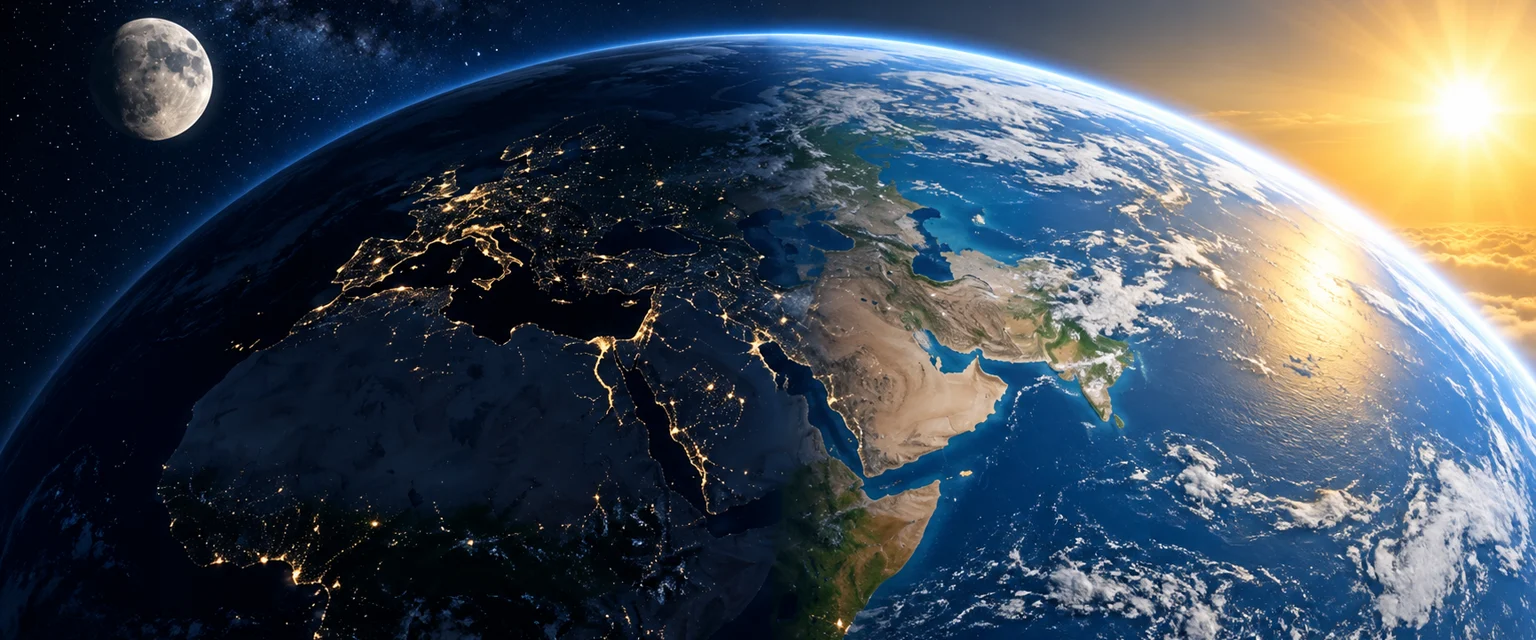
Earth’s rotation creates a stable alternation of light and darkness, while liquid water and biological clocks shape living systems. This episode follows the sequence of night, day, water, and vision in Surah An-Nur.
Tip: If the video will not play here, click Watch on Vimeo.
This episode uses a vertical player for its original short-form format.
From a physics and biology perspective, the alternation of night and day is not just a poetic image — it is a direct consequence of Earth’s rotation and a key ingredient for a stable, life-supporting environment.
يُقَلِّبُ ٱللَّهُ ٱلَّيْلَ وَٱلنَّهَارَ ۚ إِنَّ فِى ذَٰلِكَ لَعِبْرَةً لِأُولِى ٱلْأَبْصَـٰرِ
God alternates the night and the day. Surely in that is a lesson for those of vision.
(Quran 24:44)
“We made the night for rest, and made the day for livelihood.”
(Quran 78:9–11, excerpted in the episode)
وَٱللَّهُ خَلَقَ كُلَّ دَآبَّةٍۢ مِّن مَّآءٍۢ ۖ فَمِنْهُم مَّن يَمْشِى عَلَىٰ بَطْنِهِۦ وَمِنْهُم مَّن يَمْشِى عَلَىٰ رِجْلَيْنِ وَمِنْهُم مَّن يَمْشِى عَلَىٰٓ أَرْبَعٍۢ ۚ يَخْلُقُ ٱللَّهُ مَا يَشَآءُ ۚ إِنَّ ٱللَّهَ عَلَىٰ كُلِّ شَىْءٍ قَدِيرٌۭ
And God has created from water every living creature. Some of them crawl on their bellies, some walk on two legs, and some walk on four. God creates whatever He wills. Surely God is Most Capable of everything.
(Quran 24:45)
لِّأُو۟لِى ٱلْأَبْصَـٰرِ
…for people of vision (insight).
Quran 24:44 states that God alternates the night and the day. Immediately afterward, verse 24:45 reminds us that all living creatures were made from water. The episode pauses over that sequence because, scientifically, the two ideas are deeply connected.
If Earth did not rotate relative to the Sun and therefore did not experience alternating night and day, it could become tidally locked: one side facing the Sun while the other remained in darkness. That would produce far more extreme temperature contrasts and make widespread, stable surface liquid water less likely.
Without widespread stable liquid water, the transition of life from aquatic environments to land would also become less likely. Earth’s rotation does more than give us sunsets: it moderates global temperature, influences atmospheric and oceanic circulation, contributes to the conditions in which the planetary magnetic field is maintained, and establishes biological rhythms on which life depends.
The Quran also says, “We made the night for rest, and the day for livelihood” (78:9–11). The episode compares that description with circadian biology. Animals active at night are nocturnal, while humans and many other visually oriented animals are diurnal and depend heavily on stable cycles of daylight and darkness.
Quran 24:44 ends by saying that in this is a lesson for those who have vision—li-ulī al-abṣār. The episode emphasizes vision because night and day form a light-based, observable sign. Vision became our dominant sense within that daylight environment and helped shape human brains, behavior, learning, and social life.
The alternation of night and day is therefore more than a poetic image. It is foundational to a world in which life can emerge from water, adapt to changing environments, and thrive.