Watch the Episode
Tip: If the video will not play here, click Watch on Vimeo.
Note: this episode was filmed vertically; the science content is compact, but the ideas expand naturally.
In Islamic tradition, Isra’ wal Mi’raj is the Journey and Ascension associated with the Prophet Muhammad (peace be upon him). This episode treats the description of al-Burāq as a science-focused thought experiment—not a re-interpretation of hadith— and explores parallels with relativity, geodesics, and the physics of light.
Note: Scholars and believers differ on how to understand Isra’ wal Mi’raj (physical journey versus divinely inspired dream). This page presents the physics ideas in a way that remains compatible with a “dream imagery” framing.
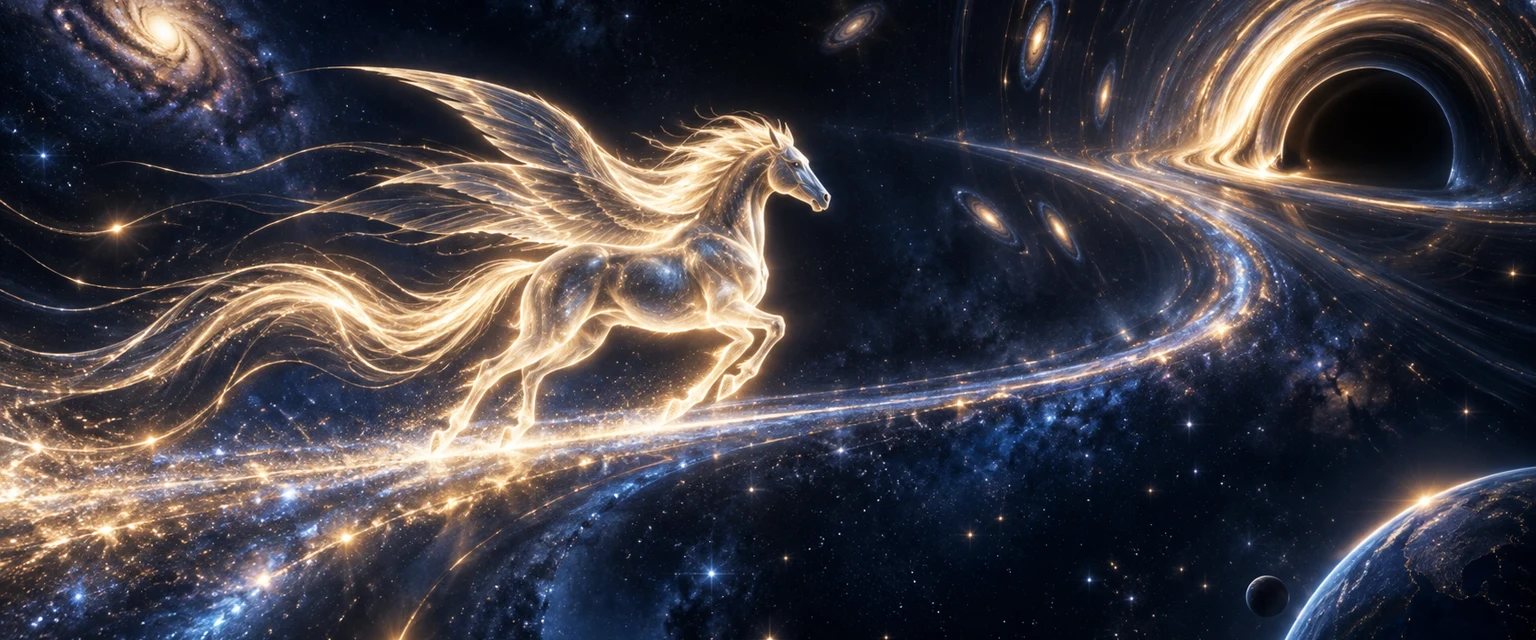
Tip: If the video will not play here, click Watch on Vimeo.
Note: this episode was filmed vertically; the science content is compact, but the ideas expand naturally.
“I was brought al-Burāq, who is an animal white and long, larger than a donkey but smaller than a mule, who would place its hoof a distance equal to the range of vision.”
If we treat Burāq as an analogy for a coherent beam of light, the hadith imagery can be “read” as a compact way of referencing several physical descriptors:
In ordinary perception, white suggests a blend across the visible range rather than a single monochromatic frequency. As an analogy, it points toward a range of visible frequencies and wavelengths.
The narrative fixes a destination (Jerusalem) and therefore a direction of travel. In geometric terms, the route is slightly west of true north along a great-circle path. In optics language, that is the beam’s propagation direction.
A flashlight spreads; a laser remains comparatively narrow and structured. “Reaching the destination intact” maps naturally to a coherent beam rather than scattered light. Coherence refers to a stable phase relationship over space and time, and coherence implies a well-behaved phase structure, even if phase is not mentioned explicitly.
If an upright axis is imagined as perpendicular to the direction of motion, it becomes a visual handle for polarization—the direction in which the electric field oscillates.
In physics, electromagnetic amplitude is measured in V/m, not meters. Still, for a thought experiment, a memorable “height” can serve as a visual proxy for field amplitude. From amplitude, we infer intensity and energy (since intensity scales with amplitude squared).
Taken together, this creates a compact optics scaffold: spectrum, direction, coherence/phase, polarization, and amplitude/intensity—wrapped into a single image.
Isra’ and Mi‘raj is significant because, through this miraculous night journey and ascension, the Prophet Muhammad (peace be upon him) was given the command for the five daily prayers; it also signifies honor, spiritual elevation, and a meaningful link between the sanctity of Mecca and Jerusalem.
This page keeps the primary religious meaning intact while using the imagery as a springboard for scientific reflection.
[Opening]
In the Islamic tradition, there is a remarkable story known as Isra’ wal Mi’raj—the Journey and Ascension. Muslims believe that the Prophet Muhammad, peace be upon him, traveled from Mecca to Jerusalem, ascended to the heavens, and then returned in a single night. Some understand this as an actual physical journey, while others see it as a divinely inspired dream. The first part of that journey was made on a miraculous, white steed called al-Burāq, a name derived from the Arabic word barq, meaning lightning, brilliance, or radiance.
[Hadith + imagery]
The Prophet describes Buraq using extraordinary imagery. In Sahih Muslim, he says:
“I was brought al-Buraq, who is an animal white and long, larger than a donkey but smaller than a mule, who would place its hoof a distance equal to the range of vision.”
In other words, each stride reached the furthest point of its line of sight. Buraq, the creature whose very name is linked to light, arrives at its line-of-sight destination in an instant while still at his point of origin.
[Transition to physics]
In Einstein’s theory of relativity, something interesting happens as objects move faster and faster: time slows down for the traveler. And for something traveling at the speed of light—like a photon—time itself effectively stops along its path.
A photon can leave a distant galaxy, travel millions of light-years, and, in the language of relativity, the departure and arrival occur with zero proper time between them. From the photon’s “perspective,” no time passes at all. That is similar to Buraq.
[Geodesics]
But there’s another layer. Light doesn’t just travel quickly—it travels along what physicists call a geodesic: the straightest possible path through spacetime. A geodesic is literally a “line of sight” path that minimizes distance in the geometry of the universe.
So a photon’s journey is: instantaneous in its own time, direct along the limit of its vision, moving as fast as nature allows.
In physics, a light wave or beam can be described by several key properties: frequency, wavelength, amplitude, polarization, phase, direction, coherence, and intensity.
The description of Buraq is fascinating in that it can be mapped onto all of these. If we treat Buraq as an analogy for a beam of light, what would we know about that light?
[Back to Buraq]
The imagery of Buraq overlaps the physics of light in striking ways: a name linked to light, a description that can be mapped to the properties of a light wave, and a stride that instantaneously reaches to the horizon of sight that echoes how light behaves according to the theory of relativity.
Isra’ and Mi‘raj is significant because, through this miraculous night journey and ascension, the Prophet Muhammad (peace be upon him) was given the command for the five daily prayers, was honored with direct encounter with God affirming his prophethood and his status with the other prophets in history, linking the sanctity of Mecca and Jerusalem, and offering Muslims a model of spiritual elevation. And it all started with an image of traveling on a beast that seems to be an analogy to the physics of light.
SubhanAllah.
Visit my new website at http://www.DoctorG.Science for more information.
[Title card]
“Appendix: Buraq, Amplitude, and the Power of Light”
I posted before about Buraq, the prophet’s miraculous steed, as a thought experiment: A dream image that, whether you see it as purely symbolic or divinely inspired, lines up in surprising ways with what we now know about light and relativity.
We spoke about: the name Buraq, tied to lightning; the description maps to many properties of light; and the way Buraq moves—placing its hoof at the limit of its sight—like light following a geodesic, the straightest possible path through spacetime.
Now, I want to zoom in on one detail that often gets overlooked: Buraq’s size.
The hadith in Sahih Muslim says Buraq was: “an animal white and long, larger than a donkey but smaller than a mule.” That seems like an odd thing to emphasize in a miraculous journey. Why do we need to know that it’s taller than a donkey but shorter than a mule? Here’s one way to think about it—not as a final interpretation, but as a thought experiment.
Amplitude: the “height” of a wave
In physics, when we talk about a wave—whether on a string, in water, or a light wave—we describe: its frequency (how many wiggles per second), and its amplitude (how tall those wiggles are). For light, the amplitude tells us how strong the electric and magnetic fields are. And that maps directly to intensity: Small amplitude → dim light; Large amplitude → bright, powerful, potentially destructive light.
The intensity of light actually scales with the square of the amplitude. Double the amplitude, and you get four times the intensity. So, if we treat Buraq’s height as a metaphor for amplitude, then this white, lightning-named creature isn’t just “fast”; it represents very intense light.
What does extreme intensity do?
You’ve already experienced this in everyday life: sunlight feels different from the light of your phone screen. A laser pointer can be bright and sharp. Industrial lasers can literally cut metal. All of that comes from increasing the amplitude and therefore the intensity of the electromagnetic field.
At truly extreme intensities, light can: ionize atoms (stripping electrons away), exert noticeable radiation pressure (physically pushing on objects), and in the most extreme theoretical regimes, intense fields can even create particle–antiparticle pairs from the vacuum. So, in physics, very intense light is not “just brighter.” It becomes something you cannot ignore. It changes its environment.
Bringing it back to Buraq
White → a whole band of frequencies in the visible range. Height between a donkey and a mule → a concrete, memorable visual that you can read, in a thought experiment, as a stand-in for amplitude. Name from “lightning” → intense, sudden, powerful discharge. Motion “to the extent of its sight” → a geodesic-like line of sight through spacetime. And, from relativity, light traveling such paths experiences no time along its own trajectory.
If you choose to see Isra’ and Mi’raj, or at least the Buraq portion, as an inspired dream, then that dream begins to look like a kind of guided thought experiment: Imagine something that behaves like light, moves along a geodesic, experiences essentially no time on its journey, spans a range of frequencies, and has an intensity so great that it can carry you from one domain of reality to another.
SUBHANALLAH.
Why this matters
For Muslims who love science, this way of looking at the hadith does two things: It does not replace the traditional story. But it does invite you to see the story as rich enough to hold, within its imagery, ideas that resonate with modern physics.
And if a single dream image from 1,400 years ago can open a door to discussions about wave amplitude, frequency, geodesics, and time dilation, then maybe that’s a good reminder that studying physics is not separate from faith for many believers. It can actually deepen the sense of awe at how finely structured this universe is.