Watch: Quran on Buruj
Tip: If the video will not play here, click Watch on Vimeo.
Note: this episode is a short-form reflection on Quranic language, classical interpretation, and the large-scale structure of the universe.
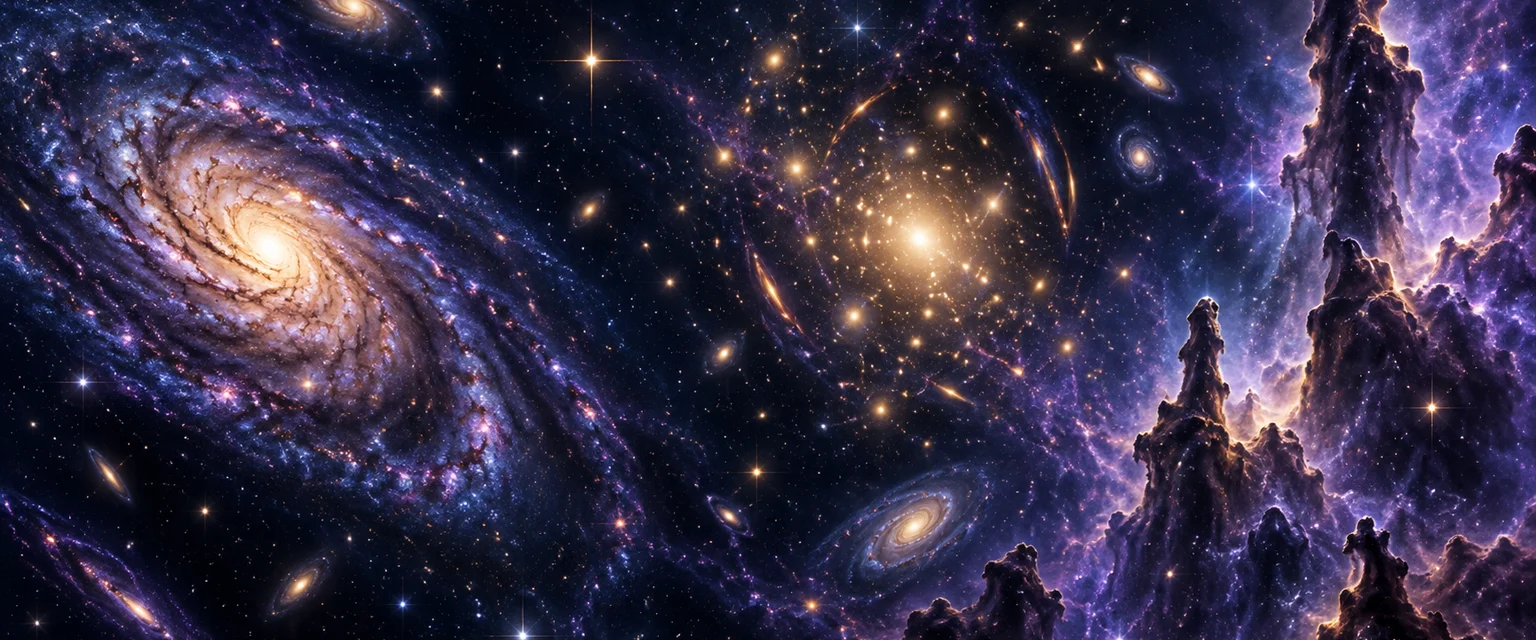
The word burūj is often translated as constellations, yet its wider semantic field evokes lofty, visible, fortified structures. This episode asks whether galaxies better capture that three-dimensional cosmic architecture.
Tip: If the video will not play here, click Watch on Vimeo.
Note: this episode is a short-form reflection on Quranic language, classical interpretation, and the large-scale structure of the universe.
This page presents an interpretive possibility, not a claim of unanimous classical consensus. Historically, interpreting burūj as constellations made sense because ancient observers recognized stable star groupings as the obvious landmarks of the night sky. But the Arabic term itself may be broader and more structural than that translation suggests.
On this reading, the Quranic language is not confined to imaginary star drawings. It may be invoking the idea of visibly prominent, elevated, ordered structures in the heavens. That makes the comparison with galaxies especially interesting in the modern era.
A key contrast in the episode is the difference between constellations and galaxies.
The episode uses that contrast to ask whether burūj might resonate more strongly with real luminous structures than with projected star patterns.
أَيْنَمَا تَكُونُوا يُدْرِككُّمُ الْمَوْتُ وَلَوْ كُنتُمْ فِي بُرُوجٍ مُّشَيَّدَةٍ
Wherever you may be, death will overtake you, even if you should be within lofty, fortified towers.
(Quran 4:78)
وَلَقَدْ جَعَلْنَا فِي السَّمَاءِ بُرُوجًا وَزَيَّنَّاهَا لِلنَّاظِرِينَ
And We have certainly placed in the sky burūj and adorned it for the observers.
(Quran 15:16)
تَبَارَكَ الَّذِي جَعَلَ فِي السَّمَاءِ بُرُوجًا وَجَعَلَ فِيهَا سِرَاجًا وَقَمَرًا مُّنِيرًا
Blessed is He who placed in the sky burūj, and placed therein a radiant lamp and an illuminating moon.
(Quran 25:61)
وَالسَّمَاءِ ذَاتِ الْبُرُوجِ
By the sky full of burūj.
(Quran 85:1)
We’ve always been told that in the Quran, the word Burūj means constellations—little dots connected by imaginary lines, ancient hunters and bears drawn in the sky. But what if the Quran is describing something much, much bigger? Something not just observed, but constructed? Today, we’re looking at Burūj as the true architecture of the universe.
Traditionally, scholars interpreted burūj as the constellations—the recognizable star patterns visible to the naked eye. Historically, that makes perfect sense. These patterns were the landmarks of the night sky for travelers and navigators.
But as we do on this channel, let’s look at the linguistics. Burūj comes from the root B–R–J. It does not mean a pattern. It means something elevated, prominent, visible, and highly structured. It implies a tower or a fortified citadel.
The Quran itself confirms this usage. In Surah An-Nisa, Allah says: أَيْنَمَا تَكُونُوا يُدْرِككُّمُ الْمَوْتُ وَلَوْ كُنتُمْ فِي بُرُوجٍ مُّشَيَّدَةٍ “Wherever you may be, death will overtake you, even if you should be within lofty, fortified towers.” A burj is not an illusion. It is a structure.
Now look at how burūj appears in the sky verses of Surah Al-Hijr and Surah Al-Furqan. We are told these burūj are placed as adornment, separate from the sun and moon.
Here is the scientific reality. For most of human history, we didn’t know what those large fuzzy patches in the night sky actually were. The Milky Way was just a band of light. Andromeda was just a smudge.
But in the modern era, astronomers showed that Andromeda was not a cloud. It was an island universe—a separate, massive stellar system. Compare that to constellations. Constellations are largely an optical illusion: flat drawings of stars that are often not physically connected at all. They lack real structure.
But galaxies? Galaxies are real, gravitationally bound, three-dimensional architecture. They are held together by gravity. They have boundaries. They are luminous structures in the heavens.
So when the Quran begins Surah Al-Buruj with the oath: وَالسَّمَاءِ ذَاتِ الْبُرُوجِ “By the sky full of burūj,” that oath may carry a scale of cosmic majesty far greater than ancient sky drawings alone.
SubhanAllah.